
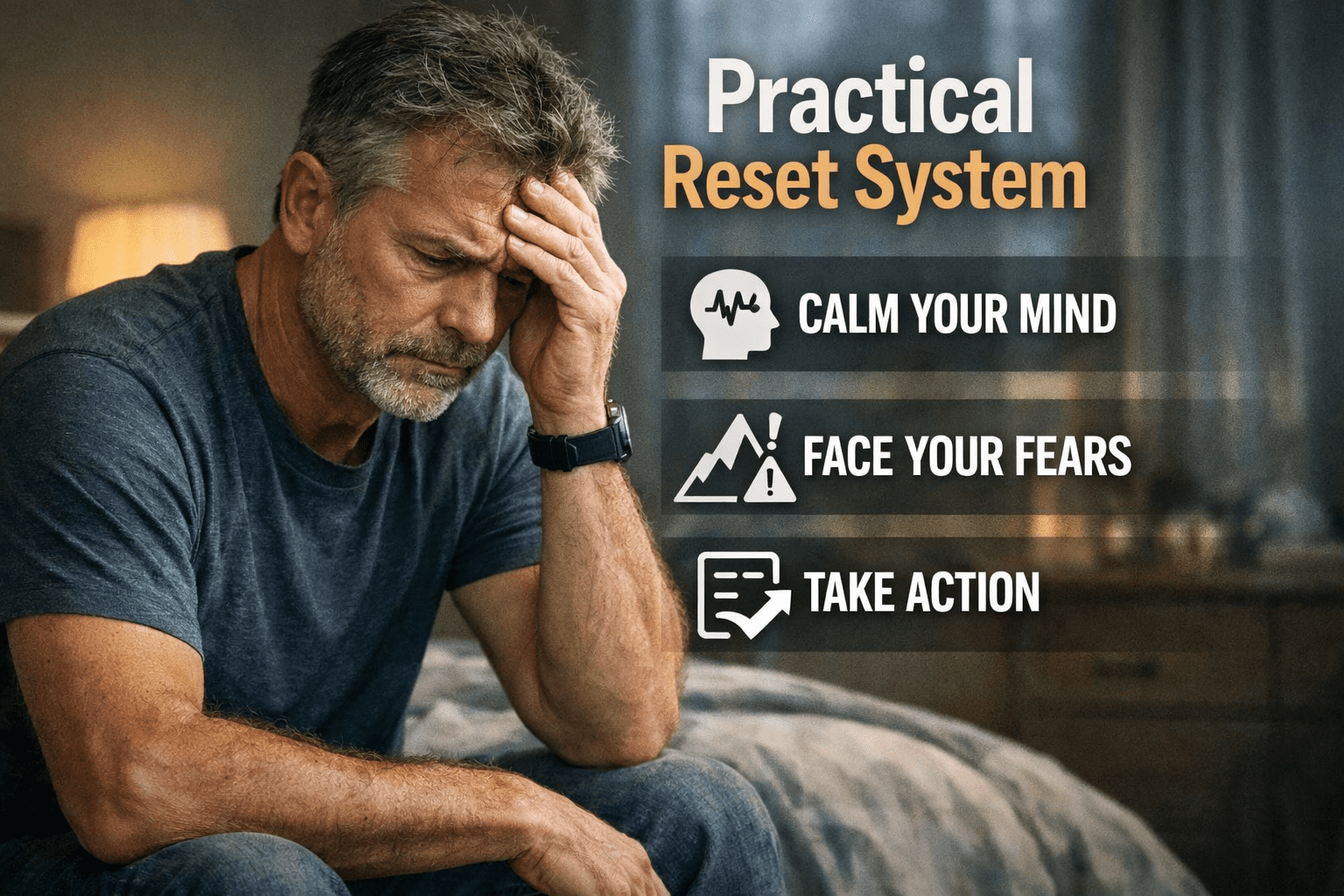
Key Takeaways
Midlife anxiety in men isn’t proof you’re weak—it’s proof something matters. Use this 6-step system to calm the spiral (7-minute reset), separate facts from the story, release pressure without self-destructing, repair mistakes, and talk to one safe person.
Who this is for? men 35–65 dealing with anxiety, layoffs, marriage stress, shame, panic-y spirals, or “I feel like a fraud” thoughts.
Midlife Anxiety in Men: It Starts With What You Believe
We were taught to believe we were the strong ones. That weakness, emotion, fear, anxiety weren’t supposed to be in our vocabulary. So we jumped off the cliff with our eyes wide open into the abyss, and we were not supposed to utter so much as a peep of fear the entire way down.
Life can be scary. And as a man—especially in the middle innings of life—it can be downright terrifying at times. Not because you’re “soft.” Because you’re carrying a lot. And you rarely have anyone you can talk to about the dreaded F word.
Feelings.
Believe it or not, we all experience fear, anxiety, regret, sadness, and sometimes just an overall sense that it’s all too much. Our partners and kids rely on us. Our co-workers and employees look to us. Our relatives and friends admire us.
And sometimes we don’t feel like any of that is earned.
Or worse—sometimes it feels like everything you’ve worked for is slowly ebbing away. Quietly. Consistently. Like a leak you can’t find.
Why Midlife Anxiety Hits Men so hard
If you’ve ever been laid off… if you’ve ever said the wrong thing or done the wrong thing… if you’ve ever lost the nest egg, gotten a scary report from the doctor, cheated on your spouse, embarrassed your kids, lost your temper, lost your purpose—then you’ve visited this place.
The place where the feelings we were told never to feel suddenly show up anyway.
Our instinct is to suppress them. Hide them. Outrun them. Lie to ourselves that we’re even feeling them at all.
But they’re there.
Constant. Stabbing. And ironically, they keep us from solving the problems that brought them up in the first place.
So we reach for coping mechanisms. Alcohol. Sex. Gambling. Food. Work. Scrolling. Whatever makes the volume go down for five minutes—even if it makes the problem bigger tomorrow.
The fact is: we’re human. We screw up. We lose. We feel.
So let’s start with the uncomfortable truth:
You’re not broken. You’re not weak. You’re not “failing at being a man.”
You’re just a person trying to get through day-to-day life while carrying a lot of invisible weight.
And here’s the other truth nobody says out loud: a lot of us don’t feel like men. We feel like little boys playing dress-up. As businessmen. As husbands. As fathers. As authority figures. Like any moment someone could walk in and go, “Hey—what are you doing in that outfit?”
So… now what?
We’ve acknowledged our feelings. We’re sitting in the circle of kumbaya (if I misspelled that I don’t care) and admitted out loud that sometimes the shit hits the fan and it affects us in deep, meaningful ways.
It messes with us. It knocks the wind out of us. It makes it hard to get back on our feet.
Is it time for therapy? Is it time for change? Is it time to stop pretending these feelings don’t have an impact?
Yes.
But not in the way you think.
Because the first move isn’t “become a different person.” The first move is stop bleeding internally and call a timeout.
Most men don’t need a personality transplant.
They need a system.
A way to deal with fear and shame without stuffing it down, blowing up, or disappearing into tequila, porn, DoorDash, or doomscrolling like it’s a second job.
So here’s the system.
attacking Midlife Anxiety in Men – The System You Need
Step 1: The 7-Minute Reset (When You’re Spiraling)
When fear shows up, your brain starts running disaster math. It wants to solve your entire life in one sitting. That’s when guys make dumb choices—because you’re trying to rebuild the house while the smoke alarm is screaming.
Your job in that moment is not to fix everything.
Your job is to get your nervous system back online.
Do this:
- Name what’s happening:
Say it out loud: “I’m flooded.”
Not “I’m dying.” Not “everything’s over.” Just: “I’m flooded.” - Breathe like you mean it (10 rounds):
Inhale 4 seconds, exhale 6 seconds.
That longer exhale tells your body, we’re not being chased. - Unclench your face and hands:
Yes, really. The body is the remote control for the brain. You can’t “think” your way out if your body is in fight-or-flight. - Ask one question:
“What is the next true, useful step… not the final step?”
Then do the next step. Not the whole plan. One brick.
Email. Walk. Shower. Appointment. Invoice. Apology. One brick.
Step 2: Separate Facts From the Story You’re Believing
Middle-aged fear isn’t just fear. It’s usually fear plus a story.
- “If I got laid off, I’m done.”
- “If my kid saw that, I’m a fraud.”
- “If my marriage is shaky, I’m a failure.”
- “If my doctor said that, it’s game over.”
- “If people knew the truth about me, they’d leave.”
Here’s the move: Facts vs. Story.
The 2-Column Drill (3 minutes)
Grab Notes on your phone.
Column A: Facts (no drama, just reality)
Column B: Story (the meaning your brain is adding)
Example:
- Fact: “I’m 56 and I got laid off.”
- Story: “I’m washed. I’ll never recover. I’m embarrassing.”
Now add a third line:
Column C: A Better Story (one that creates action)
- “This is a hit. It’s not the end. I’ve rebuilt before. My next move is to stabilize income and protect my confidence.”
This isn’t “positive thinking.” It’s leadership.
You’re choosing a story that creates motion instead of paralysis.
Step 3: The One Rule About Feelings Nobody Taught Us
Feelings aren’t instructions.
They’re indicators.
Fear = “Something matters.”
Shame = “I think I’m unlovable if people see this.”
Anger = “A boundary or value got hit.”
Sadness = “Something needs to be grieved, not fixed.”
If you treat feelings like enemies, they go underground and run your life from the basement.
The “Name It” Script (no therapy voice required)
Try this:
- “I’m feeling fear about money and I’m telling myself I won’t recover.”
- “I’m feeling shame about what I did and I’m telling myself I’m a bad person.”
- “I’m feeling anger because I don’t feel respected and I’m telling myself I have no control.”
That’s it.
Not a poem. Not a breakdown. Just clarity.
When you name it, you stop living inside a vague fog.
Step 4: Replace “Coping” With Pressure Release (same job, lower cost)
Most coping isn’t evil. It’s pressure relief… with a brutal interest rate.
So keep the pressure relief. Swap out the method.
Here are some “2 out of 10” swaps—meaning they’re easy enough that you’ll actually do them:
- Instead of alcohol → sparkling water + a 10-minute walk
- Instead of porn scroll → cold shower + music
- Instead of gambling spiral → text a buddy: “I’m white-knuckling tonight”
- Instead of rage scrolling → lift something heavy, even if it’s in your garage
- Instead of isolating → sit outside for 8 minutes, no phone, just air
You don’t need perfect habits.
You need one reliable off-ramp.
Step 5: If You Messed Up (yes, that kind of messed up)
Some guys reading this aren’t just stressed.
They’re carrying a secret.
Cheating. Lying. Blowing savings. Saying something unforgivable. A moment that now feels like a stain.
Here’s what I’ll tell you as a therapist who’s heard it all:
You are not the worst thing you’ve ever done.
But you do have to handle it like a grown man.
The adult repair plan
- Own it without performing
No long speeches. No “but you made me.” No courtroom defense. - Repair with actions, not promises
Transparency. Boundaries. Consistency. Doing what you say you’ll do. - Get accountability
One person who knows the truth and won’t let you slip back into fantasy. - Learn the pattern
What were you avoiding? What were you starving for? What boundary were you too scared to set?
Shame says: “Hide.”
Strength says: “Repair.”
Step 6: The One Conversation That Changes Everything
You don’t need twenty deep talks.
You need one honest sentence with someone safe.
Try one of these:
- “I’m not okay lately, and I’m handling it poorly. I don’t need you to fix it—just be in it with me.”
- “I’ve been carrying a lot of fear. I’m trying to stop pretending.”
- “I’m ashamed about something, and I don’t want it to keep running my life.”
This is how men stop being “alone in a crowd.”
And yes—your friends can handle it more than you think. Most of them are relieved someone finally said it first.
So… is it time for therapy?
Sometimes yes. Sometimes no. Sometimes “not yet.”
Therapy isn’t a personality change. It’s a gym for the skill you never got taught.
If any of these are true, don’t white-knuckle it:
If “therapy” feels too big, start smaller: one session. A men’s group. A coach with real credentials. A trusted friend. A pastor you respect. A doctor visit to rule out medical stuff that can mimic anxiety.
The point isn’t the label.
The point is momentum.
The Bottom Line: Start With One brick
You were taught to believe fear meant you were weak.
But fear is often a signal that you’re at the edge of something that matters—change, risk, growth, truth.
So here’s what I want you to believe instead:
- You can be strong and scared.
- You can be responsible and overwhelmed.
- You can be a good man and have made mistakes.
- You can feel the feelings without letting them run your life.
You don’t have to become a different person.
You just need a better system.
Start with one brick. Start Tonight.
This is the first in a series of articles that are intended to help Men with Midlife Anxiety and finding healthy ways to face it, handle it, and fix it. Stay tuned for more…
-
Is midlife anxiety normal for men?
Yes. It’s common — and it’s usually context, not weakness. Midlife stacks pressure: money, aging parents, health, marriage friction, job insecurity, identity shifts, and the silent expectation that you’re supposed to be “fine.” Anxiety shows up when your brain is trying to protect you from real or perceived threat. The goal isn’t to “never feel it.” The goal is to respond skillfully so it doesn’t run your life.
-
How do I stop spiraling at night?
Night spirals happen because your brain has less distraction and your nervous system is already tired. Use a simple three-part rule:
Name it: “I’m spiraling. My brain is doing disaster math.”
Get your body calm first: 10 rounds of breathing (inhale 4 seconds / exhale 6 seconds).
Do one brick: a tiny action that reduces helplessness (send one email, schedule one call, write tomorrow’s 3 tasks, put shoes by the door for a walk).
If you try to “think your way out” while your body is in fight-or-flight, you’ll lose. Calm first. Then one brick.
-
What’s the fastest way to calm my nervous system?
The fastest reliable method is a longer exhale plus a physical release cue.
Do this for 2–3 minutes:-Inhale 4 seconds
-Exhale 6–8 seconds
-Repeat 10–15 times
-Then unclench your jaw, hands, and shoulders on purpose.That longer exhale tells your body, we’re not being chased. Once your physiology drops even 10%, your brain becomes usable again.
-
What does midlife anxiety look like in men?
Often not “panic attacks on the floor.” It can look like:
-irritability or snapping
-insomnia or 3AM dread
-doomscrolling / overworking
-chest tightness, racing thoughts
-avoiding decisions
-drinking/eating/scrolling to shut your brain off -
How do I know if it’s anxiety or something medical?
If symptoms are new, intense, or scary—get checked. Anxiety can mimic heart and thyroid issues, and medical issues can mimic anxiety. A quick doctor visit is not “dramatic.” It’s smart risk management.
-
I feel like a fraud in midlife – Why?
Because midlife strips away the old scripts. Promotions, approval, momentum—things that used to validate you—can slow down. The brain fills that gap with a story: “I’m exposed.” That’s not truth. It’s fear narrating. And it’s false. You’re not a fraud.
-
What’s the difference between stress and anxiety?
Stress is usually tied to a specific problem. Anxiety is your brain running worst-case simulations on repeat—even when nothing is happening in the room. Stress says “handle this.” Anxiety says “everything is unsafe.”
-
Should I talk to my partner about this?
Yes—if you do it cleanly. Try one sentence:
“I’m not okay lately, and I don’t need you to fix it—just be in it with me.”
That reduces isolation without turning your partner into your therapist.
-
Is therapy the only answer?
No. Therapy helps, but it’s not the only lever. Start with:
-one honest conversation
-a men’s group
-a coach with real credentials
-sleep + movement + less alcoholThe goal is momentum, not a label.
-
When is anxiety serious enough to get help?
If any of these are true, don’t white-knuckle it:
-poor sleep for weeks
-panic symptoms feel out of control
-you’re using substances to cope most days
-rage is leaking onto your family
-you’re isolating hard
-you’ve lost joy and can’t access “normal you”We can’t give medical advice per se, but these are all signs you need to reach out to a professional.
-
What’s one daily habit that helps most?
A non-negotiable walk (even 15–30 minutes). It’s simple, it regulates your nervous system, and it creates a baseline “I’m still steering” feeling—especially when life feels unstable.
🧰 The Fix Kit: Stuff That Actually Helps You Sleep
All tested, no fluff. We only link what actually works.
- 🕶️ Felix Gray Blue-Light Glasses — because scrolling in bed isn’t going away.
- 🧊 Eight Sleep Pod Cover — your half of the bed deserves A/C too.
- 💊 Magnesium Glycinate (Beam Dream / Thorne) — like a nightcap that won’t text your ex.
- 🎧 Hatch Restore 2 — gentle light + sound that doesn’t hate you.