
A career change at 50 is not a refresh.
It’s not a rebrand.
And it’s definitely not a personality test disguised as advice.
It’s a structural change — to how you work, how you earn, and how much of your identity you tie to your job.
At this stage of life, most men aren’t asking “What do I love?”
They’re asking harder, quieter questions:
- What still makes sense financially?
- What am I actually willing to tolerate now?
- How much risk can I take without blowing up my family’s stability?
- How do I stay relevant without pretending I’m 30?
This article is about answering those questions honestly — and building a midlife career change that fits who you are now, not who you were trained to be.
Why career change at 50 feels uniquely disorienting
A Why career change at 50 feels heavier than earlier pivots
A career change after 50 carries weight because more is at stake.
You’re not just changing jobs — you’re adjusting:
- income expectations
- time horizons
- retirement math
- family obligations
- physical energy
- tolerance for bullshit
Earlier career moves were additive.
This one is selective.
You’re no longer trying to prove yourself. You’re trying to protect your runway.
That’s why generic advice (“follow your passion,” “just network more”) feels insulting at this stage. It ignores the real constraints you’re navigating.
How layoffs change the career change equation at 50
A layoff in your 20s feels like a detour.
A layoff in your 50s feels like a referendum.
That’s not because you failed — it’s because the market has changed.
Layoffs force three decisions quickly:
- Do I try to return to the same role?
- Do I reposition into an adjacent role?
- Do I redesign how I work entirely?
The mistake many people make is rushing to answer all three at once.
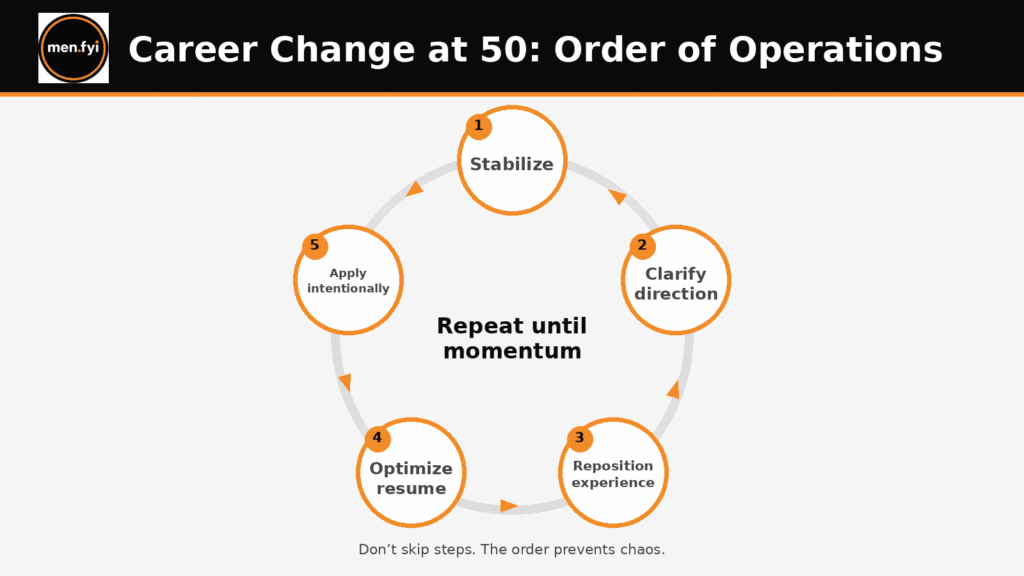
The smarter move is sequencing:
- stabilize emotionally
- assess financial runway
- clarify what not to repeat
- then design the next phase deliberately
Again, this is where your existing layoff content becomes a supporting pillar, not a distraction.
The hidden grief that comes with a midlife career change
Most men don’t talk about this part, but it matters.
A midlife career change often includes grief — even if the change is voluntary.
You may be letting go of:
- a title that carried social weight
- an industry you helped build
- a version of yourself that made sense for decades
- the assumption that things would just “continue”
If you’ve been laid off, that grief can be sharper and more disorienting. Layoffs at this stage don’t just disrupt income — they disrupt identity.
(If this resonates, your Laid Off After 50 article is a natural internal link here. It fits cleanly and adds depth without repeating content.)
The myth that holds people back: “I’m too late”
One of the most damaging assumptions in a job change at 50 is the idea that you missed your window.
In reality:
- You’re not too late — the market just changed
- Your experience isn’t a liability — it’s unlabeled
- The problem isn’t age — it’s signal
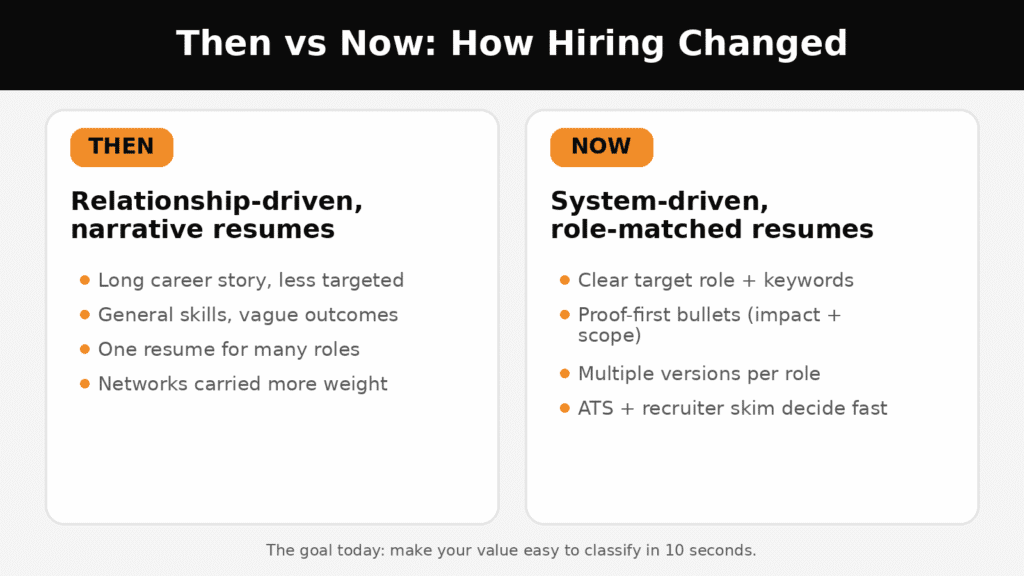
Most people attempting a career change at 50 don’t fail because they can’t do the work. They fail because they present themselves the way they always have — and the system no longer reads it the same way.
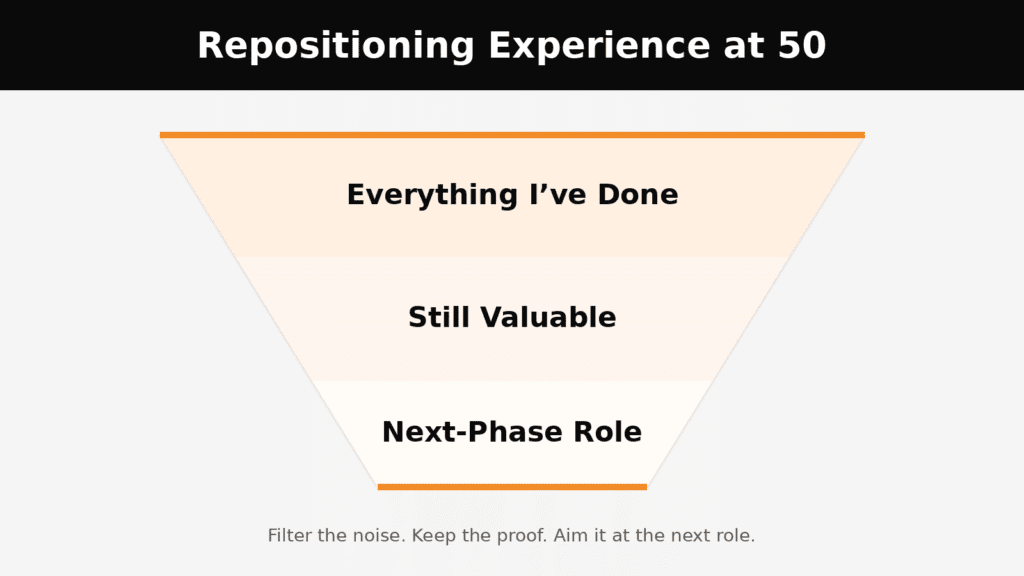
Career change at 50 is about repositioning, not reinvention
Here’s the most important reframe:
You are not starting over.
You are deciding which parts of your experience still earn their keep.
A career change at 50 is fundamentally about repositioning — choosing:
- which skills remain core
- which environments you’re done with
- which trade-offs you no longer accept
This is where clarity begins.
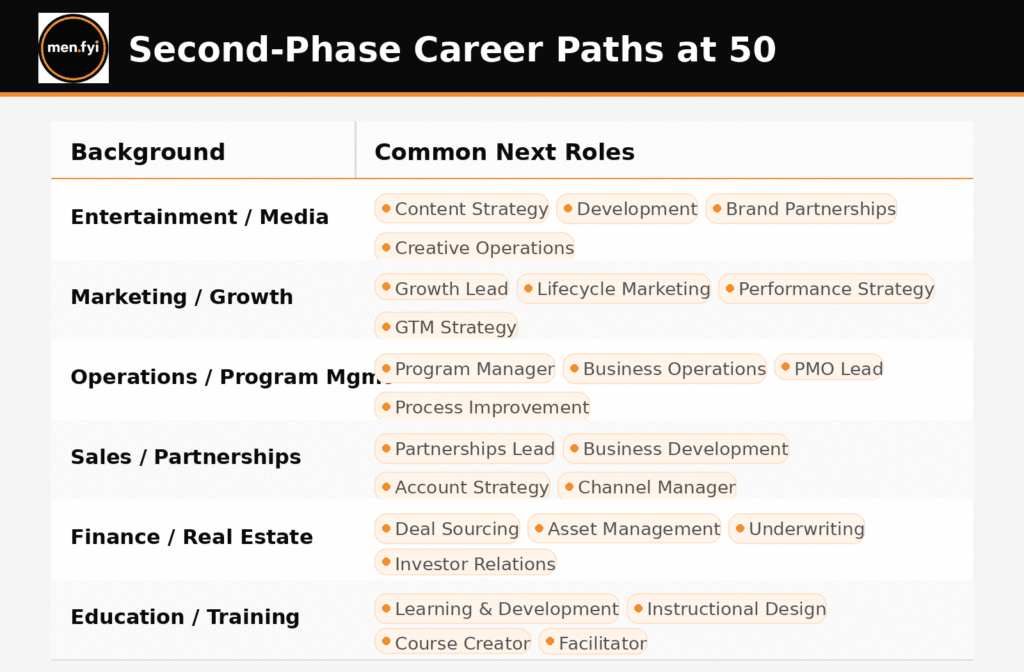
What different careers often morph into at 50
This is the section most articles skip — and the one people actually want.
Below are realistic second-phase paths based on what we see experienced professionals move into successfully.
Engineers and technical professionals
At 50, many engineers no longer want:
- constant tool churn
- late-night deploys
- being managed by people half their age
Common next-phase paths include:
- Technical advisor or architect roles
- Consulting or fractional work
- Internal enablement / mentoring roles
- Vendor-side roles (solutions, implementation, partnerships)
The value shift here is from execution to judgment.
Executives and senior leaders
Executives often discover that what exhausted them wasn’t leadership — it was scale, politics, and constant visibility.
Second-phase options often include:
- Fractional executive roles
- Operating advisor / board roles
- Private equity portfolio support
- Smaller companies with real leverage
- Teaching, mentoring, or paid advisory work
This is where control over calendar becomes as important as compensation.
Creatives, media, and brand professionals
Many creatives hit a wall with:
- instability
- taste cycles
- age bias
- declining budgets
Common pivots include:
- Strategy and planning roles
- Content leadership vs production
- Education, coaching, or course creation
- Independent publishing (newsletters, niche sites)
- Advisory roles to younger teams
This is less about “doing less” and more about owning the thinking layer.
Operators, project managers, and generalists
Generalists often struggle most online because their value is broad.
Strong next-phase paths include:
- Program leadership
- Internal transformation roles
- Process consulting
- Operations leadership in smaller orgs
- Hybrid roles combining ops + strategy
The key here is learning to label breadth clearly, not apologize for it.
The resume problem (and where it fits — quietly)
At some point in a career change after 50, resumes matter again.
But not as identity documents.
They are translation tools.
Most midlife resumes fail because they:
- describe what happened, not what’s transferable
- rely on implied seniority
- use legacy language for modern roles
This is where ATS and resume mechanics come in — but as support, not the headline.
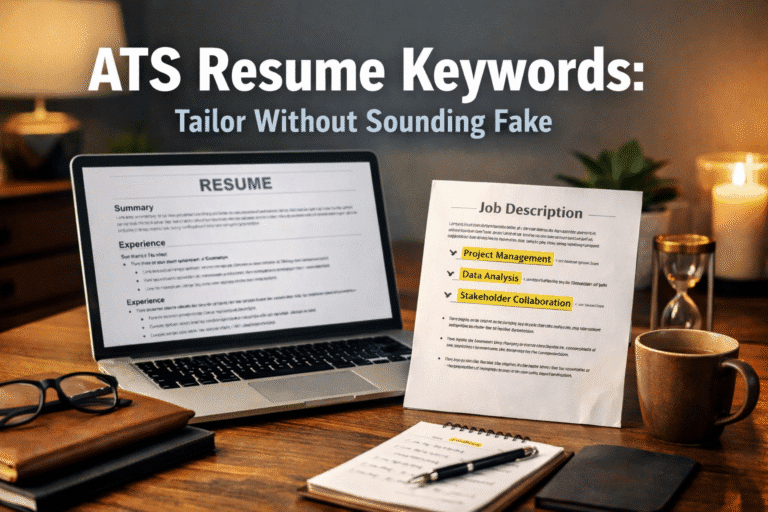
You’ve already covered this well in your ATS Resume Keywords and resume-focused posts. This article should link to those resources, not duplicate them.
PRO TIP: Create a professional ATS-friendly resume in minutes with Teal’s free Resume Builder.
The financial reality no one wants to admit
A job change at 50 forces financial honesty.
You may need to:
- decouple income from identity
- accept a temporary dip to regain control
- prioritize stability over upside
- adjust retirement assumptions
This is not failure. It’s strategy.
Many men make worse decisions by refusing to adjust expectations than by adjusting too early.
Trust me on this one — I just assumed the money would always be there. But it was once I made a plan and put it into action.
What actually helps people recover momentum
Across hundreds of midlife career changes, a few patterns repeat:
- Fewer applications, more intentional ones
- Clear boundaries around what’s no longer acceptable
- Parallel tracks (income + repositioning)
- Systems instead of willpower
- Calm instead of urgency
Momentum doesn’t come from confidence.
Confidence comes after momentum returns.
Final thought
A career change at 50 isn’t a step down — it’s a deliberate narrowing.
Earlier in life, possibility mattered more than precision. You said yes to things because they taught you, stretched you, or kept doors open. At this stage, the work is different. You’re no longer collecting experiences. You’re deciding which ones still earn space in your life.
That shift can feel like loss at first. In reality, it’s leverage.
When handled with intention, this phase often produces outcomes that were difficult to reach earlier:
- work that respects your time instead of consuming it
- autonomy over how and when your expertise is used
- a clearer professional identity, stripped of unnecessary noise
- and roles that align with who you are now, not who you were expected to be
This isn’t a consolation prize for aging out of something.
It’s the result of finally having enough perspective to choose well.
A second act done right doesn’t look louder.
It looks cleaner, calmer, and more sustainable — and it fits.
🧰 The Fix Kit: Stuff That Actually Helps You Sleep
All tested, no fluff. We only link what actually works.
- 🕶️ Felix Gray Blue-Light Glasses — because scrolling in bed isn’t going away.
- 🧊 Eight Sleep Pod Cover — your half of the bed deserves A/C too.
- 💊 Magnesium Glycinate (Beam Dream / Thorne) — like a nightcap that won’t text your ex.
- 🎧 Hatch Restore 2 — gentle light + sound that doesn’t hate you.