
If you’re applying online and hearing nothing back, there’s a decent chance your resume isn’t getting rejected because you’re unqualified. It’s getting rejected because it’s not being read the way you think it’s being read.
Most companies run resumes through an ATS first.
ATS stands for Applicant Tracking System—the software that collects applications, parses resumes, and helps recruiters sort candidates. Some ATS tools are basic filing cabinets. Others score and rank resumes. But the common thread is simple: the system is looking for matching language.
That’s where ats resume keywords come in.
This article will show you how to:
- Build an ATS resume keywords list for a job in minutes
- Place keywords where they actually matter
- Tailor your resume for ATS without turning it into keyword soup
- And keep the thing sounding like a confident adult human being
ATS Resume Keywords: Quick Tips
– An ATS is a sorting system. It looks for relevance signals and matching phrases.
– Your job is not to “beat” it. Your job is to be easy to classify as a match.
– You only need 8–12 high-signal ats resume keywords per job, not 50.
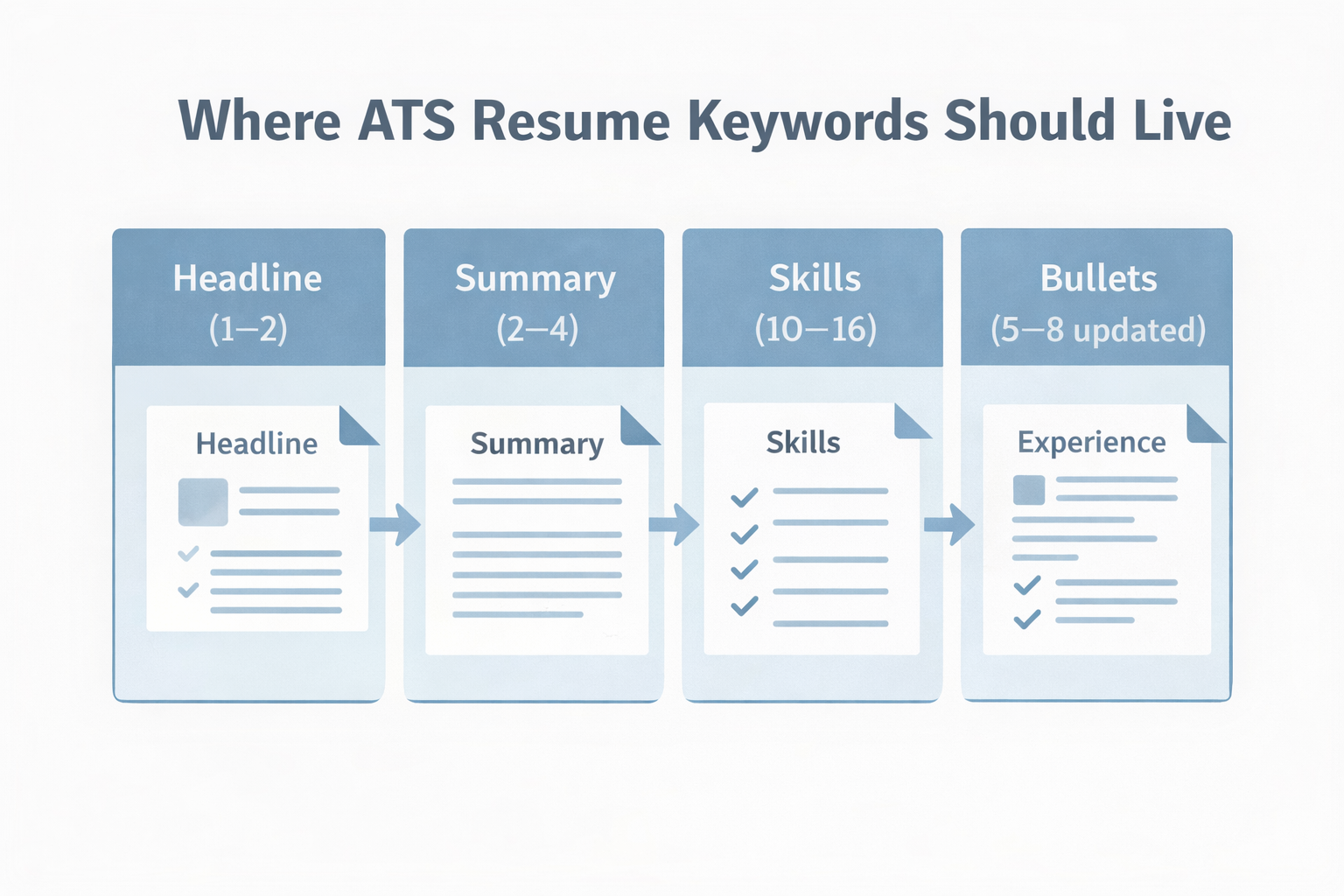
– Update four zones: Headline, Summary, Skills, and 5–8 bullets.
-If you want structure, read my teal resume builder review and be sure to grab the
Resume Reset Checklist (PDF)
What the hell does ATS stand for?
ATS stands for Applicant Tracking System.
It’s the software companies use to collect applications, store resumes, and help recruiters sort candidates. Think of it like a filing system with filters. Some ATS platforms are basic databases. Others include screening questions, keyword matching, ranking, and automated workflow steps.
The important part: whether the system is “smart” or not, it still relies heavily on one thing—the words and phrases in your resume matching what the job post asks for.
If you and the job post are speaking different languages, you can be a perfect fit and still look like a “maybe” in the system.
What an ATS is actually doing (plain English)
What an ATS actually does (and why keywords matter)
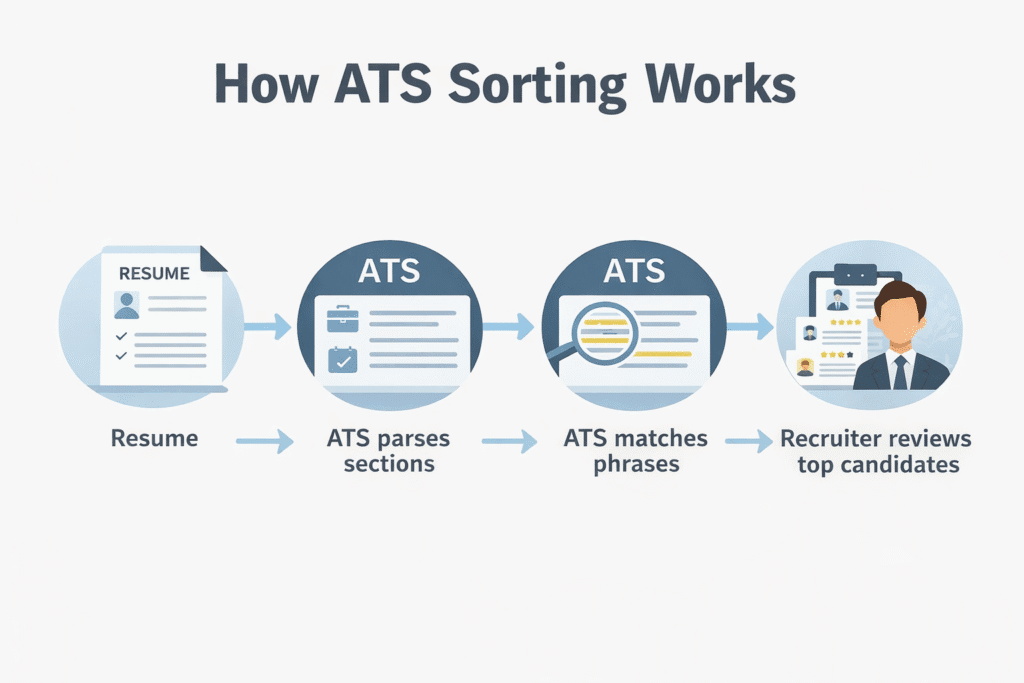
An ATS generally does three things:
- Parses your resume (pulls out titles, employers, dates, skills)
- Matches your language against the job description
- Sorts or ranks candidates so recruiters can review a smaller pile
This is why two people can be equally qualified, but one gets interviews and one disappears into the void. The one who gets interviews usually:
- uses the same core phrases as the job post
- makes key skills obvious in predictable places
- describes impact clearly instead of implying it
An ATS friendly resume isn’t “robotic.” It’s simply clear and well-labeled.
The biggest mistake experienced candidates make
If you have 15–30 years of work behind you, it’s easy to write a resume like a career autobiography. That often leads to:
- broad language (“oversaw,” “responsible for,” “managed”)
- long lists of duties
- too much context
- not enough clear, modern phrasing aligned to the role
The ATS—and the recruiter—can’t infer your value. You have to label it.
This is why a small ATS resume keywords tune-up can change everything. Not because you’re gaming the system, but because you’re translating your experience into current hiring language.
The 12-minute method: build your ATS resume keywords list
This is the repeatable workflow. Use it every time you apply to a job you actually want.
Step 1: Build an ATS resume keywords list (4 minutes)
Open the job description and pull out phrases from four buckets:
Bucket A — Skills
Examples: strategy, stakeholder management, project management, analytics
Bucket B — Tools
Examples: GA4, HubSpot, Asana, Salesforce, SQL, Figma
(Only include tools you genuinely know.)
Bucket C — Deliverables
Examples: roadmaps, dashboards, playbooks, editorial calendars, reporting
Bucket D — Outcomes
Examples: growth, retention, conversion, revenue, cost reduction, efficiency
Now look for repetition. Repeated phrases are your priority.
Target: 8–12 phrases that are clearly central to the job.
Example keyword list (varies by role):
- content strategy
- cross-functional leadership
- stakeholder management
- KPI reporting
- roadmap planning
- SEO strategy
- experimentation / A/B testing
- lifecycle marketing
- go-to-market

Step 2: Place keywords in the only four zones that matter (6 minutes)
This is where people waste hours. Don’t rewrite the whole resume. Just hit these zones:
Zone 1 — Headline
Match the job title and core function.
- “Content Strategy Lead | Audience Growth | KPI Reporting”
- “Program Manager | Cross-Functional Delivery | Stakeholder Management”
Zone 2 — Summary (3–5 lines)
Naturally include 2–4 phrases from your keyword list.
Example:
I lead content strategy and cross-functional teams to drive measurable growth. I’m known for stakeholder management, clear roadmaps, and KPI reporting that improves decision-making and execution.
Zone 3 — Skills (10–16 items)
This is the cleanest place to include keywords without ruining your voice.
Pro tip: group skills into 2–4 clusters:
- Strategy: Content Strategy, GTM, Positioning
- Growth: SEO, Lifecycle, Conversion
- Ops: Roadmaps, KPIs, Stakeholders
- Tools: GA4, Search Console, Asana
Zone 4 — Experience bullets (5–8 bullets total)
Update only the bullets most likely to be skimmed:
- your most relevant recent role
- your best outcomes
- your most transferable wins
This is how you optimize your resume for ATS without making the page unreadable.
Step 3: Add one “mirror bullet” (2 minutes)
Pick one top requirement from the job post and mirror it—truthfully.
If the post emphasizes “stakeholder management,” your bullet should say stakeholder management in context:
- “Managed stakeholders across product, marketing, and creative to ship X on deadline…”
If the post emphasizes “KPI reporting,” your bullet should show it:
- “Owned KPI reporting and weekly performance reviews; improved retention by 12%…”
This single step often does more than “adding keywords” because it connects the phrase to real evidence.
How to tailor your resume for ATS without sounding fake
Keyword stuffing is obvious. It reads like:
- a list of disconnected phrases
- tools you don’t use
- vague claims with no outcomes
Use this rule instead:
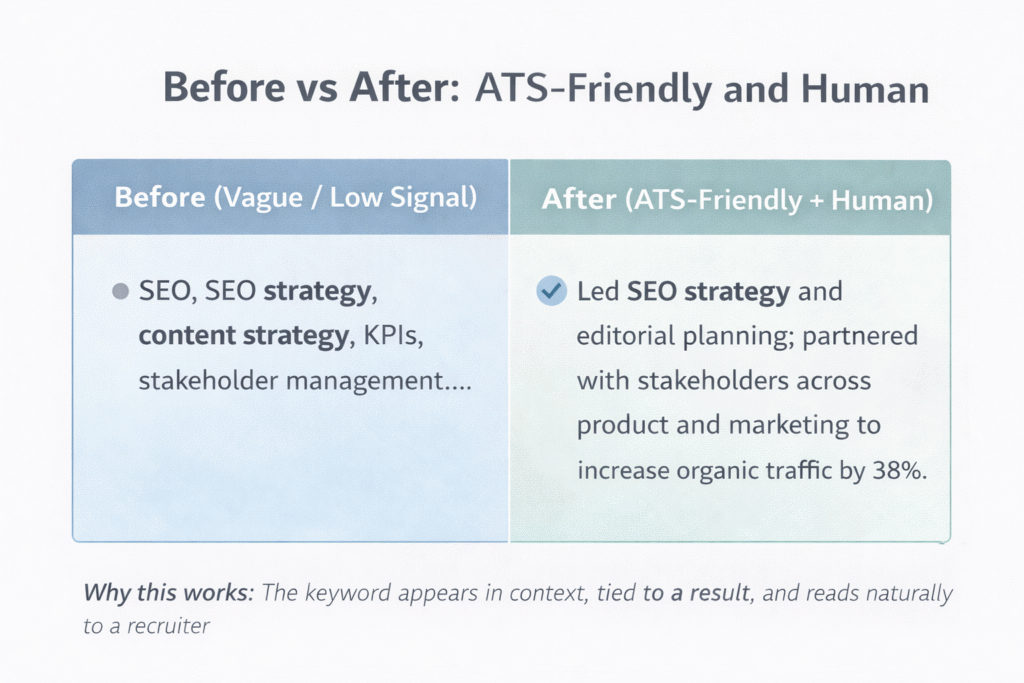
If you can’t put the keyword in a sentence with a result, it doesn’t belong.
Bad:
- “SEO, SEO strategy, content strategy, KPIs, stakeholder management…”
Better:
- “Led SEO strategy and editorial planning; partnered with stakeholders across product and marketing to increase organic traffic by 38%.”
That’s an ATS friendly resume: readable, specific, and aligned.
Before/after examples (patterns you can steal)
Example 1: vague → specific
Before: Oversaw multiple teams and drove performance across key initiatives.
After: Led cross-functional teams across content, product, and marketing; owned KPI reporting, improving retention by 12% over two quarters.
Example 2: duties → deliverables
Before: Responsible for developing strategy and managing vendors.
After: Built the content strategy roadmap and managed vendors; delivered launch assets on time and under budget while improving conversion on key pages.
Example 3: creative → transferable
Before: Developed and produced successful projects.
After: Developed and launched projects end-to-end; managed stakeholders, budgets, timelines, and performance goals across multiple releases.
ATS reality check: this isn’t the whole game
Even if you perfectly optimize your resume for ATS, the portal shouldn’t be your only strategy.
Your best odds come from pairing ATS alignment with:
- a referral or warm intro
- a short targeted outreach note
- a LinkedIn headline that matches your target role
But the resume still matters because it’s the foundation of all of it.
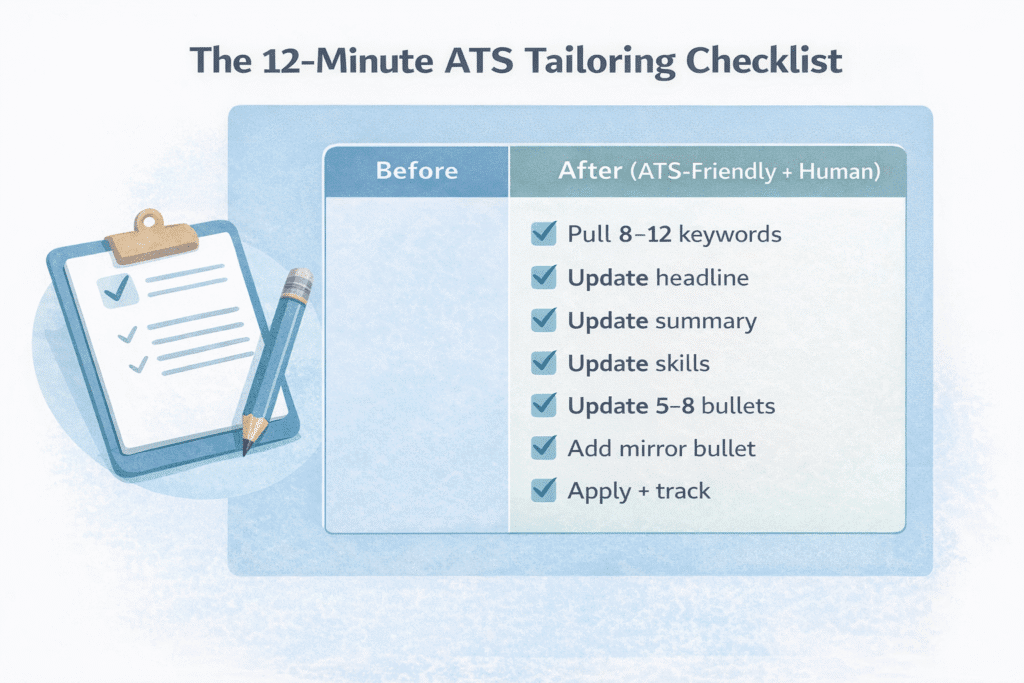
A simple workflow that keeps you sane
This is the low-friction loop that works:
- Keep a Master Resume (everything you’ve done)
- Create two versions aligned to your two target roles
- For each job you want, tailor only the four zones
- Apply, then track follow-ups so you don’t lose momentum
If you want a tool that supports this workflow, read my teal resume builder review—it’s built for resume versions + job tracking. And if you want the fast tightening pass first, download the Resume Reset Checklist (PDF).
Final word
ATS resume keywords aren’t a trick. They’re the language of the transaction. The company is “buying” a set of outcomes, and the ATS is trying to sort for those outcomes based on the words you use.
Build a small ATS resume keywords list, place phrases in the right zones, keep your bullets outcome-driven, and move on.
Momentum wins.
🧰 The Fix Kit: Stuff That Actually Helps You Sleep
All tested, no fluff. We only link what actually works.
- 🕶️ Felix Gray Blue-Light Glasses — because scrolling in bed isn’t going away.
- 🧊 Eight Sleep Pod Cover — your half of the bed deserves A/C too.
- 💊 Magnesium Glycinate (Beam Dream / Thorne) — like a nightcap that won’t text your ex.
- 🎧 Hatch Restore 2 — gentle light + sound that doesn’t hate you.
Similar Posts
Laid Off After 50: What Now? (Your No-Panic Playbook)
Laid Off After 50: What Now? (Your No-Panic Playbook) Let’s call it what it is. Getting laid off after…
Teal Resume Builder Review (2026): 7 Essential Pros & Cons for Midlife Job Seekers
Teal resume builder review: Midlife job hunting doesn’t need motivation—it needs a repeatable system. One that keeps you from…
Career Change at 50: How to Rebuild Your Work Life Without Starting Over (or Panicking)
A career change at 50 is not a refresh.It’s not a rebrand.And it’s definitely not a personality test disguised…
5 Businesses a Man Over 50 Can Start Without a Huge Investment
Top 5 Businesses For Men Over 50 Can Start Without a Huge Investment At a certain point, waiting for…