

Best Portable Power Stations for Home Backup in 2026: 5 Picks for When the Power Goes Out
If the power goes out, you probably don’t care about becoming an off-grid survivalist.
You want the refrigerator cold, you want the Wi-Fi working and you want your phone charged.
And depending on where you live, you may want a fan, CPAP, TV, coffee maker or a few lights running until the grid comes back.
That’s where a portable power station makes sense.
Unlike a gas generator, these battery-powered units can be used indoors, require no fuel, make almost no noise and can be recharged from a wall outlet, car or—on compatible models—solar panels.
The problem is figuring out how much power you actually need.
We’ve compared current models from EcoFlow, Jackery, Anker and BLUETTI to identify the units that make the most sense for ordinary home backup.]
- Best overall: Jackery Explorer 2000 v2 — the best balance of capacity, output, and portability for most homes.
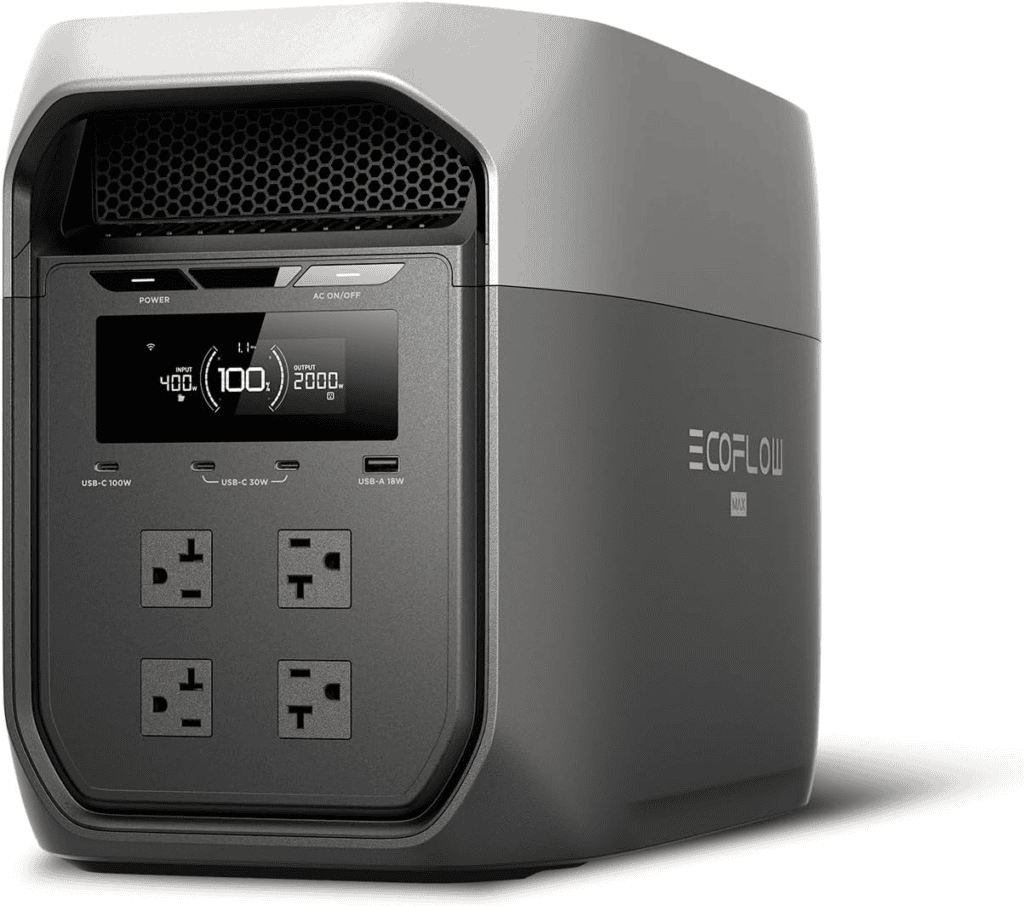
- Best value: EcoFlow DELTA 3 — enough backup power for shorter outages without spending a fortune.
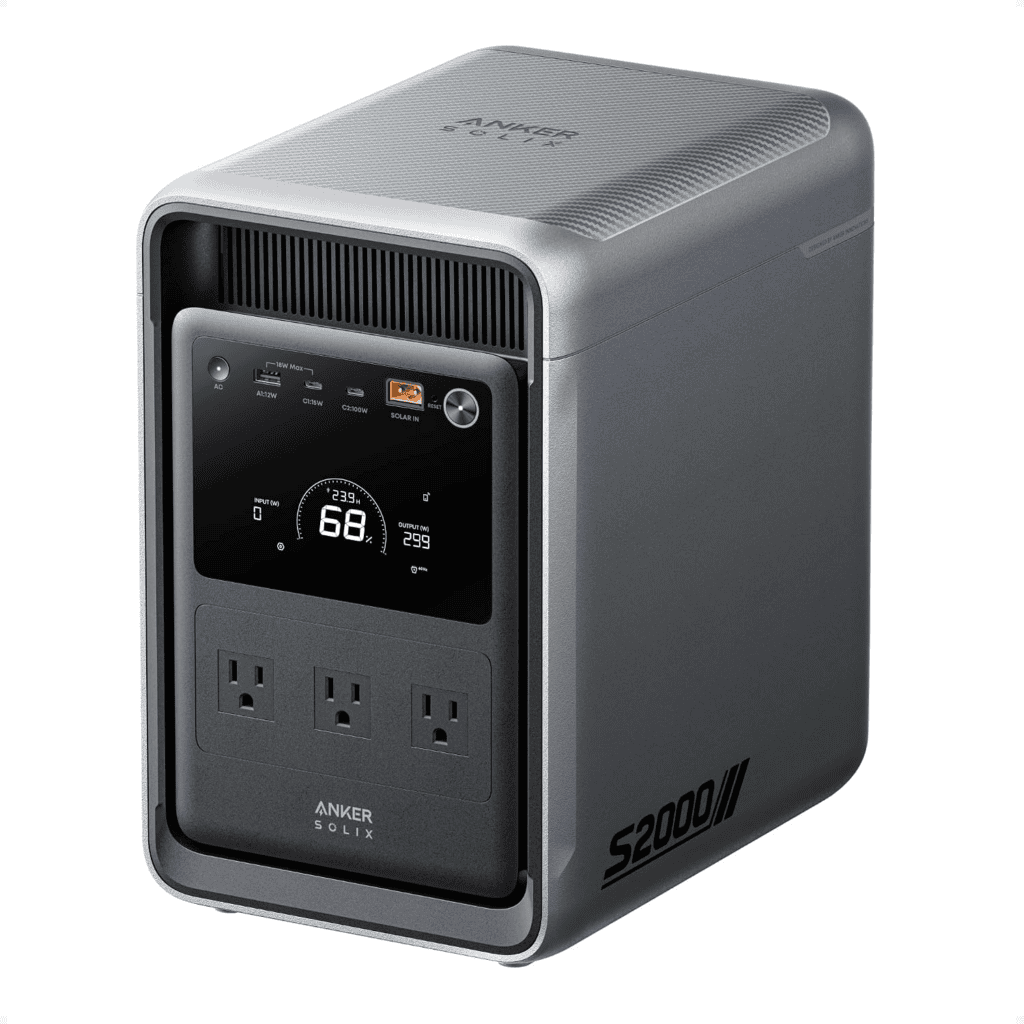
- Best compact 2kWh option: Anker SOLIX S2000 — lots of battery capacity in a relatively manageable package.
- Best for serious home backup: EcoFlow DELTA Pro 3 — massive capacity and output for longer outages.
Jackery Explorer 2000 v2 — See Today’s Price
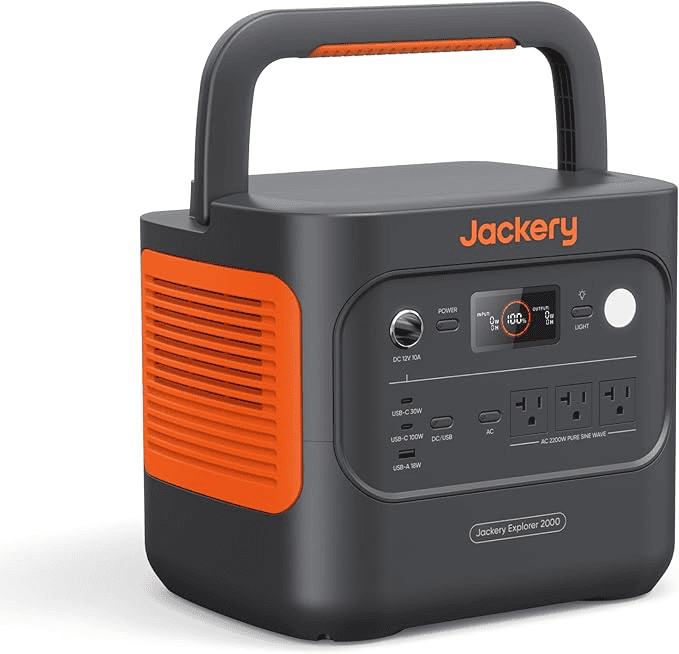
- Capacity: 2,042Wh
- Output: 2,200W
- Best for: Fridge + Wi-Fi + lights + electronics

- Capacity: 1,024Wh
- Output: 1,800W
- Best for: Short outages and essential devices

- Capacity: Approx. 2,010Wh
- Output: 1,500W
- Best for: Refrigerator backup

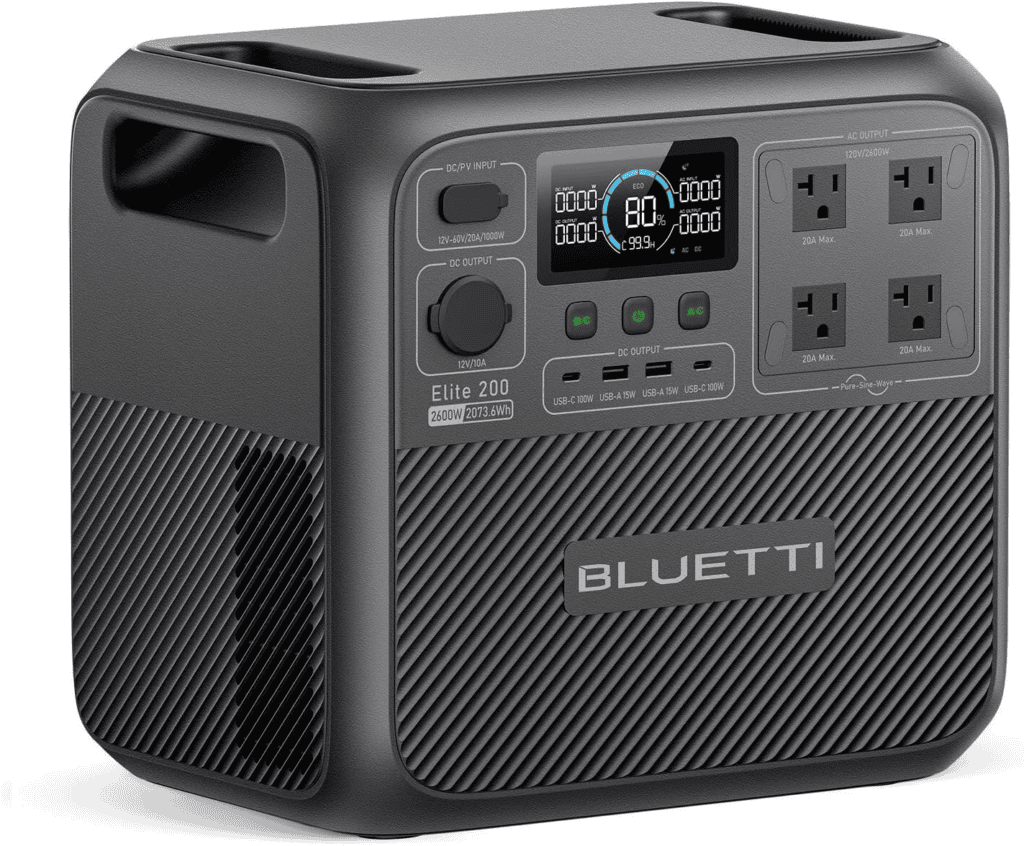
- Capacity: 2,073Wh
- Output: 2,600W
- Best for: Higher-wattage appliances

- Capacity: 4,096Wh
- Output: 4,000W
- Best for: Long outages and larger appliances
Best Portable Power Station Quick Picks
Best Overall: Jackery Explorer 2000 v2
Why We Like It
- 2,042Wh capacity is large enough for meaningful home backup.
- 2,200W continuous output can handle many common household appliances.
- At roughly 39.5 pounds, it’s relatively portable for a 2kWh unit.
What Could Be Better
- Still heavy enough that you won’t want to carry it around unnecessarily.
- Solar panels add significantly to the total cost.
- A 2kWh battery still isn’t a substitute for whole-home backup during a multiday outage.
Typical price: Often around $1,000–$1,500 depending on sales and bundles.
Jackery lists the Explorer 2000 v2 at 2,042Wh with 2,200W output, while recent independent field testing found it practical for a mix of appliances and electronics over a weekend. (Tom’s Guide)
Best Value: EcoFlow DELTA 3
Why We Like It
- 1,024Wh capacity is enough for shorter outages and essential electronics.
- 1,800W AC output handles considerably more than phones and laptops.Expandable battery ecosystem.
- Fast wall charging.
- Compact enough to move around the house or take camping.
What Could Be Better
- Half the capacity of the larger 2kWh models.
- Running a refrigerator plus multiple appliances will drain it considerably faster.
- Expansion batteries increase the real system cost.
Typical price: Roughly $500–$700 before bundles or extra batteries.
The current DELTA 3 has a 1,024Wh battery, 1,800W AC output and optional expansion batteries.
Best Compact 2kWh Choice: Anker SOLIX S2000
Why We Like It
- 2,010Wh capacity gives you considerably more breathing room during an outage.
- Can work as an emergency UPS for compatible electronics.
- Particularly attractive if refrigerator backup is your priority.
What Could Be Better
- Rated continuous output is lower than some competing 2kWh units.
- Price can vary dramatically depending on promotions and bundles.
- Bigger-capacity units make more sense if you’re trying to run several major appliances simultaneously.
Typical price: Frequently $700–$1,200 depending on promotions.
Anker’s current S2000 provides roughly 2,010Wh of storage. In recent real-world testing, Popular Mechanics reported that the S2000 ran a refrigerator for more than 24 hours under its particular test conditions—useful evidence for the exact job many homeowners buy one for. (Popular Mechanics)
Best High-Output Value: BLUETTI Elite 200 V2
Why We Like It
- Roughly 2,073Wh capacity.
- Strong 2,600W continuous output.
- Better suited than many smaller stations to appliances with higher power demands.
- Good middle ground between entry-level units and massive home systems.
- LiFePO4 battery technology.
What Could Be Better
- Heavier than some competing 2kWh stations.
- BLUETTI’s product lineup can be confusing.
- You’ll need to compare current sale pricing because this category is discounted constantly.
Typical price: Often around $900–$1,800 depending on retailer and promotions.
The current Elite 200 V2 is listed with 2,073Wh capacity and 2,600W continuous output.
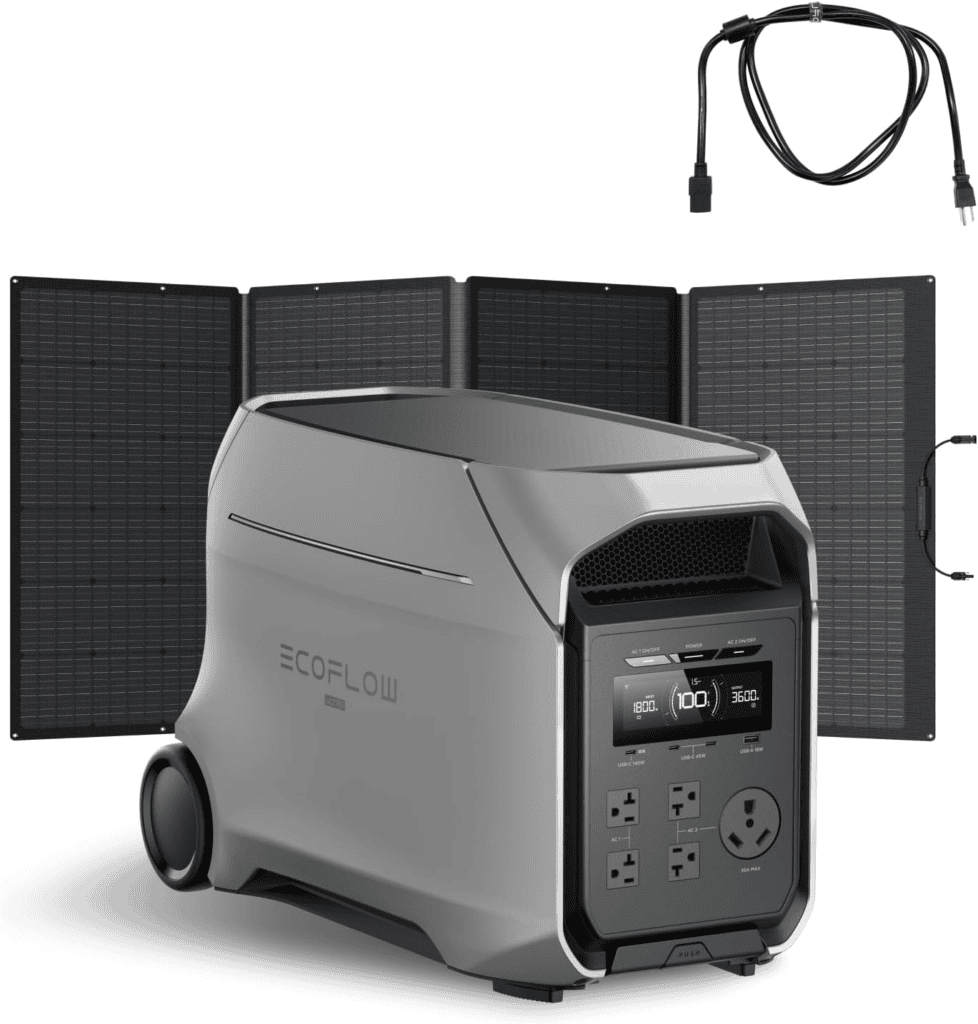
Best for Serious Home Backup: EcoFlow 3072Wh DELTA Pro 3 Ultra Plus
Why We Like It
- Massive 4,096Wh battery.
- 4,000W output.
- Can handle significantly heavier household loads.
- Expandable ecosystem.
- Better suited to long outages than smaller portable units.
- Makes sense as the beginning of a more comprehensive home-backup setup.
What Could Be Better
- It weighs more than 100 pounds.
- Expensive.
- Calling it “portable” requires a generous interpretation of the word.
- Many households don’t actually need this much battery.
Typical price: Roughly $2,500–$3,500 depending on promotions.
The DELTA Pro 3 Ultra Plus provides 4,096Wh of capacity and 4,000W output. At roughly 109 pounds, however, this is much closer to a movable home battery than something you’ll casually carry to the campsite.
Table of Contents
- What Actually Matters
- Comparison Table
- How Much Battery Do You Actually Need?
- Deep Dives
- Best Power Station for Different Situations
- Portable Power Station vs. Gas Generator
- What Can You Actually Run?
- How We Evaluated
- Alternatives
- FAQ
- Final Pick
What Actually Matters: The Cheat Sheet
Portable power station specifications look like alphabet soup.
Ignore most of it.
These are the numbers that actually matter.
Battery Capacity: “Wh”
Watt-hours (Wh) tell you roughly how much energy the battery stores.
Think of this as the size of the gas tank.
Very roughly:
- 500Wh: phones, laptop, Wi-Fi, lights
- 1,000Wh: essential electronics plus limited refrigerator/appliance backup
- 2,000Wh: serious refrigerator + electronics backup
- 4,000Wh+: longer outages and multiple appliances
Actual runtime varies significantly depending on the appliance and inverter losses.
Output: W
Watts tell you how much power the station can deliver at one time.
Think of this as engine size rather than gas-tank size.
A giant battery doesn’t help if its inverter can’t run the appliance you’re plugging into it.
Refrigerators, microwaves, coffee makers, hair dryers and power tools can all require substantial power.
Surge Output
Some appliances require much more electricity for a few seconds when their motors start.
That’s why you’ll often see:
2,200W continuous / 4,400W surge
The second number can matter for refrigerators, compressors and other motor-driven appliances.
LiFePO4 Batteries
Most modern power stations now use lithium iron phosphate, usually abbreviated LFP or LiFePO4.
That’s a good thing.
LFP batteries generally provide significantly longer cycle life than the older lithium chemistries commonly used in early portable power stations.
For something you’re buying as emergency equipment and may keep for years, battery longevity matters.
UPS Functionality
Some stations can act as a form of uninterruptible power supply.
Keep a device connected to the power station while the power station remains plugged into the wall.
If utility power disappears, the station switches over to battery.
That’s useful for things like:
- Wi-Fi routers
- computers
- security systems
- CPAP equipment
- certain medical or communication equipment
But switching specifications vary by model. If you’re using a power station for critical medical equipment, verify compatibility with the equipment manufacturer rather than assuming any UPS mode is sufficient.
Comparison Table
| Model | Capacity | Output | Best For |
|---|---|---|---|
| Jackery Explorer 2000 v2 | 2,042Wh | 2,200W | Best overall |
| EcoFlow DELTA 3 | 1,024Wh | 1,800W | Best value |
| Anker SOLIX S2000 | 2,010Wh | 1,500W | Compact 2kWh backup |
| BLUETTI Elite 200 V2 | 2,073Wh | 2,600W | High-output value |
| EcoFlow DELTA Pro 3 Ultra Plus | 4,096Wh | 4,000W | Serious home backup |
How Much Battery Do You Actually Need?
This is where portable power station shopping gets stupid.
People start comparing 1,024Wh to 2,048Wh to 4,096Wh without first answering the obvious question:
What do you actually want to keep running?
For most homeowners, there are three levels.
Level 1: Keep Me Connected
You want:
- phones
- Wi-Fi
- laptops
- LED lights
- tablets
- maybe a television
A roughly 1kWh power station is probably plenty.
That makes something like the EcoFlow DELTA 3 particularly attractive.
Level 2: Save the Food
Now add:
- refrigerator
- freezer
- Wi-Fi
- phones
- lights
- laptop
This is where we’d rather have roughly 2kWh.
The Jackery Explorer 2000 v2, Anker SOLIX S2000 and BLUETTI Elite 200 V2 become much more interesting.
Level 3: Pretend the Power Isn’t Out
You want some combination of:
- refrigerator
- freezer
- television
- computers
- coffee maker
- microwave
- fans
- lights
- electronics
- possibly other substantial appliances
Now you’re moving toward 4kWh systems like the EcoFlow DELTA Pro 3—or beyond portable power stations altogether and into dedicated home battery systems.
The more appliances you run simultaneously, the faster even a huge battery disappears.
Physics remains annoyingly undefeated.
Deep Dives
Jackery Explorer 2000 v2 — Best Overall
This is the sweet spot.
You get 2,042Wh without buying an enormous battery system.
That’s enough stored energy to make a real difference during an outage, and its 2,200W output means it can handle considerably more than chargers and LED lamps.
Jackery has also kept the unit relatively manageable at about 39.5 pounds.
That still isn’t light.
But compare it with the 109-pound EcoFlow DELTA Pro 3 and you’ll understand what “portable” means in this category.
Specs That Matter
- 2,042Wh capacity
- 2,200W output
- LiFePO4 battery
- Approximately 39.5 lbs.
- UPS functionality
- Solar charging capability
Best For
Someone who wants one portable battery for:
home outages + camping + occasional outdoor use
without buying an enormous backup system.
Heads-Up
Don’t confuse “2kWh” with unlimited power.
A high-wattage space heater can chew through a battery this size surprisingly quickly.
[CHECK JACKERY EXPLORER 2000 V2 PRICE]
EcoFlow DELTA 3 — Best Value
Not everyone needs 2kWh.
If most of your outages last a few hours rather than several days, the EcoFlow DELTA 3 may be the smarter purchase.
Its 1,024Wh capacity gives you enough power for electronics and selective appliance use without paying for battery capacity you rarely need.
The 1,800W AC output is also substantial for a unit in this class.
Specs That Matter
- 1,024Wh capacity
- 1,800W AC output
- LFP battery
- Expandable capacity
- Fast charging
- Solar compatible
Best For
Shorter outages.
Apartments.
Phones + internet + refrigerator management.
People who also want something portable enough for camping.
Heads-Up
If your primary goal is keeping a refrigerator running through overnight outages, we’d spend more for one of the 2kWh models.
[CHECK ECOFLOW DELTA 3 PRICE]
Anker SOLIX S2000 — Best Compact 2kWh Choice
Anker has turned into a serious competitor in the backup-power category.
The S2000 gives you approximately 2,010Wh in a unit weighing roughly 36 pounds.
That’s impressive for this capacity class.
Its rated output isn’t as high as the Jackery or BLUETTI options here, but efficiency matters too.
Popular Mechanics recently tested the S2000 with an actual refrigerator and reported more than 24 hours of runtime during its test. Your refrigerator, room temperature and usage pattern will obviously produce different results. (Popular Mechanics)
Specs That Matter
- Approximately 2,010Wh
- 1,500W AC output
- Up to 3,000W peak
- LFP battery
- Around 36 lbs.
- UPS capability
Best For
Refrigerator backup.
People who want approximately 2kWh without a giant box.
Heads-Up
If you’re regularly running multiple high-wattage appliances simultaneously, look at a model with greater continuous output.
[CHECK ANKER SOLIX S2000 PRICE]
BLUETTI Elite 200 V2 — Best High-Output Value
BLUETTI’s Elite 200 V2 gives you a lot of battery and inverter for the money.
The roughly 2,073Wh battery and 2,600W continuous output make it particularly interesting if your backup requirements include appliances that demand more power.
Specs That Matter
- 2,073Wh capacity
- 2,600W continuous output
- 3,900W peak output
- LFP battery
Best For
Higher-wattage appliances.
Buyers prioritizing output per dollar.
Heads-Up
It’s heavier than some competitors.
If portability matters more than maximum output, Jackery or Anker may make more sense.
[CHECK BLUETTI ELITE 200 V2 PRICE]
EcoFlow DELTA Pro 3 — Best Serious Backup
Here’s where things get serious.
With 4,096Wh capacity and 4,000W output, the DELTA Pro 3 is capable of powering considerably more equipment than the other products on this list.
But it weighs approximately 109 pounds.
You’re not throwing this thing over your shoulder.
The DELTA Pro 3 makes sense for the homeowner thinking:
I don’t just want a giant battery for camping. I want the beginnings of an actual home-backup system.
Specs That Matter
- 4,096Wh capacity
- 4,000W output
- LFP battery
- Expandable ecosystem
- Approximately 109 lbs.
Best For
Longer outages.
Multiple appliances.
Homeowners considering a more comprehensive battery-backup setup.
Heads-Up
For occasional four-hour power outages, this is probably massive overkill.
[CHECK ECOFLOW DELTA PRO 3 PRICE]
Which Portable Power Station Should You Buy?
Best for Most Homes
Jackery Explorer 2000 v2
Enough battery to matter without requiring its own zip code.
Best for Short Outages
EcoFlow DELTA 3
If you’re mostly worried about keeping internet, electronics and selected appliances running for several hours, save the money.
Best for Refrigerator Backup
Anker SOLIX S2000
The capacity/size combination is excellent, and independent refrigerator testing makes this a particularly interesting option. (Popular Mechanics)
Best for High-Wattage Appliances
BLUETTI Elite 200 V2
Its 2,600W continuous output gives it an advantage over many comparable-capacity stations.
Best for Longer Outages
EcoFlow DELTA Pro 3
It’s expensive and huge.
It’s also in another class.
What Can a Portable Power Station Actually Run?
The answer depends on two things:
How much electricity the appliance consumes and how long you run it.
A phone charger is trivial.
A refrigerator is not.
A space heater is an electricity-eating monster.
That’s why manufacturers advertising things like “powers 99% of appliances” aren’t telling you the whole story.
Being capable of turning something on isn’t the same thing as being capable of running it for eight hours.
Refrigerator
A modern refrigerator doesn’t draw its maximum rated power continuously.
The compressor cycles.
That’s why refrigerator runtime can be surprisingly decent from a 2kWh battery.
Real-world testing of the Anker SOLIX S2000 recently exceeded 24 hours with one refrigerator, although actual performance varies considerably by refrigerator and conditions. (Popular Mechanics)
Wi-Fi Router
Easy.
Your router and modem consume relatively little power compared with major appliances.
If staying online is the priority, even smaller power stations can provide substantial runtime.
Television
Usually manageable.
Just remember that four hours of television is four hours of energy you’re not saving for the refrigerator.
During an outage, apparently you’ll finally discover whether the family actually wants to talk to one another.
Microwave
Most larger power stations can run one if their inverter output is sufficient.
But microwaves draw a lot of power.
Use it to heat something.
Don’t leave it running because you’ve suddenly decided blackout night is the perfect time to experiment with slow-cooked microwave brisket.
Coffee Maker
High wattage.
Short runtime.
Usually fine on appropriately rated stations.
And arguably essential infrastructure.
Space Heater
This is where people get surprised.
Space heaters commonly pull enormous amounts of electricity relative to phones, lights and electronics.
A 1,500-watt heater can theoretically consume 1.5kWh in one hour if running continuously.
That can murder a 2kWh battery remarkably quickly.
Battery-powered home backup and electric resistance heating are not best friends.
Portable Power Station vs. Gas Generator
Portable battery stations have several advantages.
Battery Power Station
Pros
- Indoor use
- Quiet
- No gasoline
- No exhaust
- Essentially instant startup
- Minimal maintenance
- Solar charging possible
Cons
- Limited stored energy
- Recharging takes time
- Large systems get expensive
- Can’t simply pour more gasoline into them
Gas Generator
Pros
- Longer potential runtime with stored fuel
- High output available
- Often cheaper per unit of backup energy
- Well suited to extended outages
Cons
- Carbon monoxide risk
- Must be operated outdoors and safely positioned
- Noise
- Fuel storage
- Maintenance
- Engine starting
- Exhaust
For most people concerned about occasional outages, a battery is considerably easier to live with.
For someone facing frequent multiday outages, the answer may ultimately be both.
How We Evaluated These Power Stations
We didn’t pretend to personally run every one of these batteries through a refrigerator torture chamber.
Instead, we evaluated the products using:
- current manufacturer specifications
- battery capacity
- continuous AC output
- battery chemistry
- weight and portability
- expandability
- UPS capability
- solar charging options
- current retail pricing
- independent published testing
- suitability for actual home-backup scenarios
Major publications testing current power stations have likewise emphasized capacity, output, appliance performance, portability and real-world efficiency rather than simply comparing advertised battery sizes. (WIRED)
Alternatives Worth Considering
The five above aren’t the only good units on the market.
Other models worth checking include:
- Jackery Explorer 1000 v2
- EcoFlow DELTA 3 Plus
- EcoFlow DELTA 3 Max
- Jackery Explorer 2000 Plus
- Anker SOLIX C1000
- EcoFlow DELTA 3 Ultra
- BLUETTI AC180
- BLUETTI Apex 300
- Goal Zero Yeti 1500
Current independent comparisons also regularly place models from EcoFlow, BLUETTI, Jackery and Anker among the leaders in the category. (WIRED)
FAQ
What size portable power station do I need for home backup?
For electronics and short outages, approximately 1,000Wh can be enough.
For refrigerator backup plus phones, internet and lights, we’d generally prefer something around 2,000Wh.
For longer outages and multiple substantial appliances, look toward 4,000Wh+ systems or expandable home-backup solutions.
Can a portable power station run a refrigerator?
Yes, provided the unit has sufficient inverter output and capacity.
A refrigerator doesn’t usually draw its rated maximum wattage continuously because the compressor cycles on and off.
Actual runtime depends heavily on the refrigerator, temperature, how frequently the door is opened and what else is plugged into the battery.
Can I use a portable power station indoors?
Battery power stations can generally be operated indoors because they do not burn gasoline and therefore don’t produce combustion exhaust like gas generators.
Follow the manufacturer’s instructions concerning ventilation, temperature and placement.
Can I leave a power station plugged in all the time?
Some models are designed to operate in UPS/pass-through configurations.
Check the manufacturer’s instructions for your particular model before using it continuously this way.
Can solar panels recharge a portable power station?
Most of the larger models in this guide support solar charging.
How quickly they recharge depends on:
- solar panel wattage
- weather
- panel orientation
- battery capacity
- the station’s maximum solar-input specification
Solar can be extremely useful during an extended outage.
It isn’t magic.
A 200W panel does not instantly refill a 2,000Wh battery.
How long will a 2,000Wh power station run my house?
It won’t run your whole house for very long.
That’s the wrong way to think about it.
A 2kWh station is much better used strategically:
fridge + Wi-Fi + phones + lights + selected electronics
rather than attempting to operate every appliance you normally use.
Is EcoFlow better than Jackery?
Neither brand wins automatically.
EcoFlow tends to offer a sophisticated ecosystem, fast charging and extensive expansion options.
Jackery’s current systems emphasize straightforward operation and competitive power-to-weight ratios.
Pick the specific model that fits your required capacity, output and budget rather than buying exclusively by brand.
Is a 1,000Wh or 2,000Wh power station better?
For home emergency backup, 2,000Wh is substantially more useful.
For portability, camping, electronics and short outages, 1,000Wh may be the smarter value.
Buy the smallest unit that realistically handles your intended use.
Buying battery capacity you’ll never use is just storing very expensive electrons.
Final Pick
Best Portable Power Station for Most Homes: Jackery Explorer 2000 v2
The Jackery hits the balance we want:
2,042Wh capacity.
2,200W output.
Manageable size.
Useful home-backup capability.
Established ecosystem.
It’s powerful enough to be legitimately useful during an outage without pushing you into the cost, weight and complexity of a full home-battery system.
For shorter outages, save money and buy the EcoFlow DELTA 3.
For substantially longer outages, step up to the EcoFlow DELTA Pro 3.
🧰 The Fix Kit: Stuff That Actually Helps You Sleep
All tested, no fluff. We only link what actually works.
- 🕶️ Felix Gray Blue-Light Glasses — because scrolling in bed isn’t going away.
- 🧊 Eight Sleep Pod Cover — your half of the bed deserves A/C too.
- 💊 Magnesium Glycinate (Beam Dream / Thorne) — like a nightcap that won’t text your ex.
- 🎧 Hatch Restore 2 — gentle light + sound that doesn’t hate you.